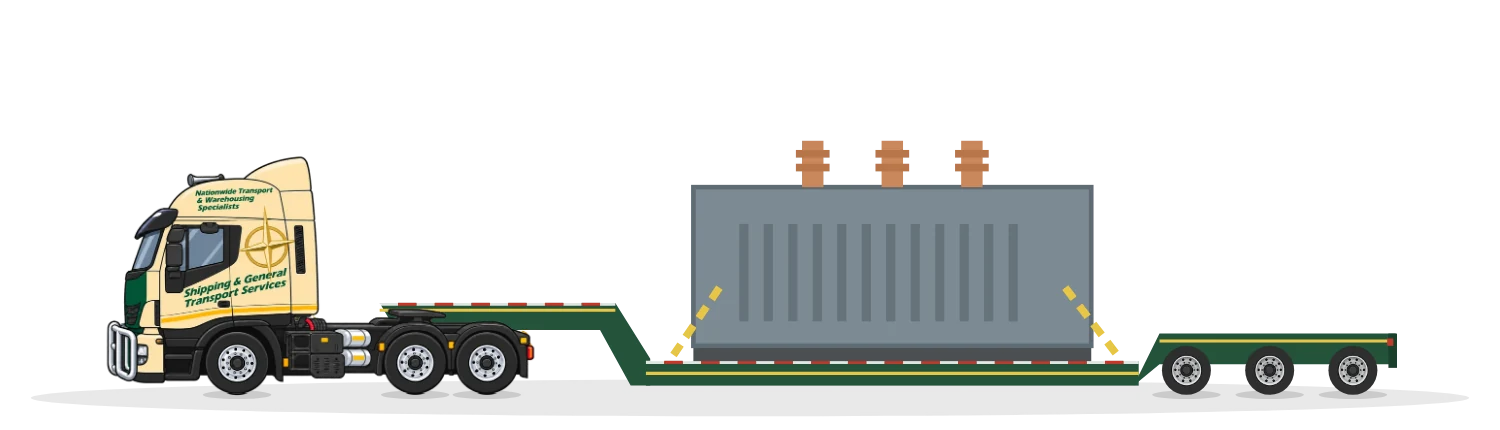
Project cargo? List the pieces first.
Each piece’s size and mass decides its truck: legal on a flat deck, or on a step deck or lowbed with a permit. List them and see your loads.
- 5Gooseneck lowbeds
- 5Step decks
- PermitsThrough every province
One project, sorted into loads.
- 01
The list
Every piece with its length, width, height and mass. Five here: 82 t.
- 02
Legal loads
Pieces inside 2.6 m wide and 4.3 m high share a flat deck: three on one truck.
- 03
Wide
The vessel is 3.2 m wide: abnormal, on a step deck, with a permit.
- 04
Tall and heavy
The transformer, 3.6 m high and 42 t, rides in a lowbed’s well, under 4.3 m, with a permit for its mass.
Request a quote for your project
Your project
Step 1 of 6- Project
- —
- Pieces
- —
- Heaviest
- —
- Route
- —
- When
- —
- Load list
- Optional
The rigs, and the limits
What our abnormal-load fleet is, and the legal limits that decide whether a piece travels like any other load or with a permit, from the National Road Traffic Regulations and TRH 11.
Our abnormal-load service
- 5 gooseneck lowbedsPurpose-designed
- 5 step decksPurpose-designed
- PermitsApplied for in every province
- Method statementAfter a risk analysis
The legal limits
- 2.6 m wideReg 223(b)
- 4.3 m highFrom the road, reg 224(b)
- 18.5 m longTractor and semi-trailer, reg 221(d)
- 56 tMost mass, regs 236, 237
Typical deck heights
A flat deck about 1.4 m off the road, so a legal piece is up to about 2.9 m high; a step deck’s lower deck about 1.05 m, up to about 3.25 m; a lowbed’s well about 0.55 m, up to about 3.75 m. Typical figures, not our trailers’ own: we confirm the trailer in the quote.
Wide pieces
Over 2.6 m wide, a piece needs a permit, and only for a load that can’t be split. TRH 11 sorts abnormal loads into classes by width and length, from D1 (up to 2.75 m wide and 27 m long) to D6 (over 4.75 m and 54 m); over 3.5 m wide calls for special markings and escorting.
Tall pieces
Over 4.3 m from the road, bridges and lines on the route must be cleared. Over 4.7 m, an own escort runs ahead with a height gauge (TRH 11). Over 5.5 m Telkom and 5.8 m Eskom must give safe passage, and may escort.
Where we operate
Our head office and 24-hour control centre are at 69–71 Barlow Road, Jupiter, Germiston, beside our container depot, where we handle heavy lifts of 1 to 50 tons, with an office in Durban.
- Germiston depot69–71 Barlow Road, Jupiter, Germiston 011 873 4786
- Durban · Greyville81 Berea Road, Greyville, Durban 031 305 0438
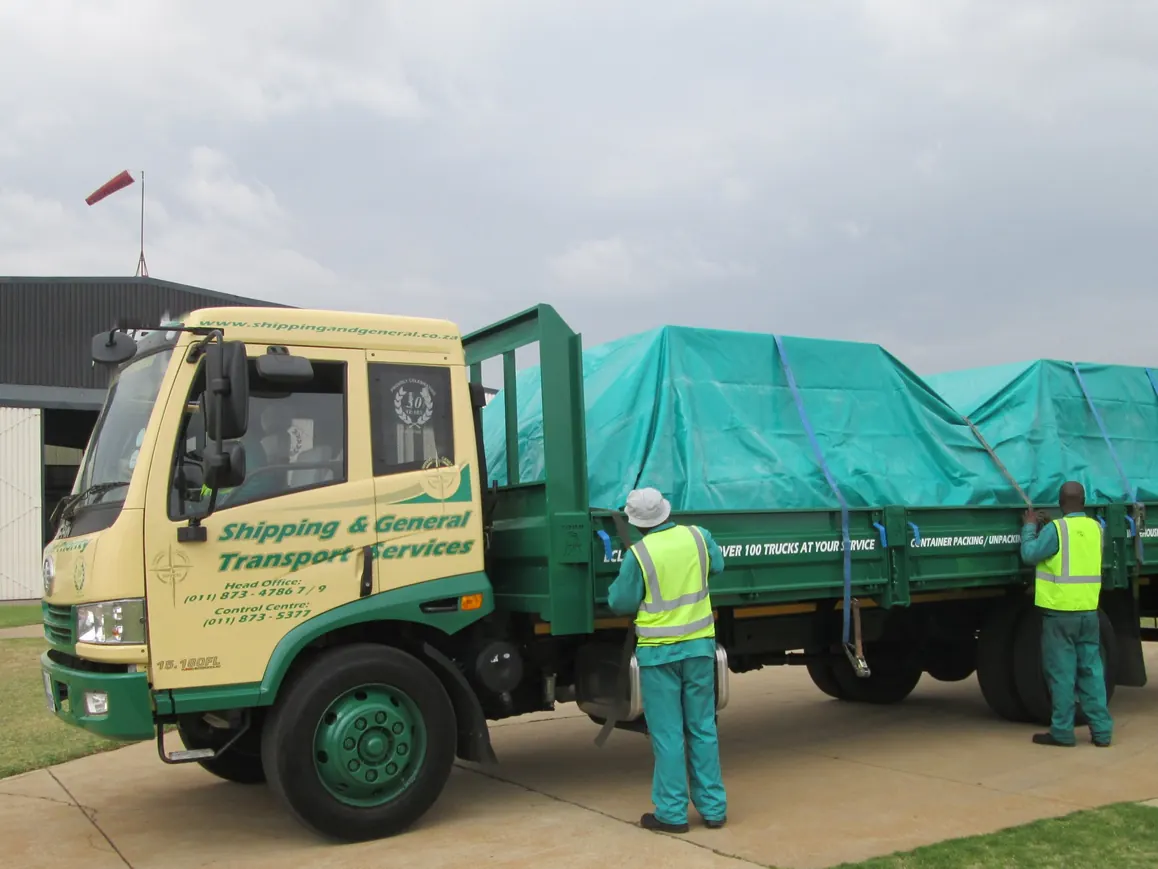

Part of Shipping & General Transport
Shipping & General Transport is a privately owned South African logistics company built on trustworthiness, perseverance and reliability. Project Cargo is one of its specialist services: a project’s pieces moved by road, legal loads on our trucks and abnormal ones on our gooseneck lowbeds and step decks, with the permits.
Visit shippingandgeneral.co.zaQuestions about project cargo
Can’t find your answer? Our team is a phone call away.
Call 011 873 4786Do you handle project cargo?
We move the pieces of a project by road: legal loads on our trucks and abnormal ones on our 5 gooseneck lowbeds and 5 step decks, with the permits, police escorts where needed, a risk analysis and a method statement. Our site doesn’t describe project cargo management as a service of its own, so tell us about the whole project and we’ll confirm what we take on.
What makes a piece abnormal?
A piece is abnormal when it can’t travel inside the legal limits on a typical trailer: 2.6 m wide (reg 223(b)), 4.3 m high from the road (reg 224(b)), 18.5 m long for a truck-tractor and semi-trailer (reg 221(d)), and the legal mass, never more than 56 t for the combination (regs 236, 237). A permit is only for a load that can’t be split.
Which trailer does a piece need?
It comes down to height and mass. A flat deck sits about 1.4 m off the road, so a legal piece is up to about 2.9 m high; a step deck’s lower deck about 1.05 m (about 3.25 m); a lowbed’s well about 0.55 m (about 3.75 m), and the lowbed carries the heaviest pieces. Typical figures, not our trailers’ own. For one tall load, see abnormallowbedservices.co.za.
How many pieces fit on one truck?
The load list plans about 30 t a load, by the deck’s length, with two pieces side by side when each is 1.25 m wide or less and nothing stacked. A real load plan also weighs the axles, the lashing points and where each piece’s centre of gravity sits, so we confirm the trucks in the quote.
Do you apply for the permits?
Yes. We apply for permits through all the provinces on the route, arrange police escorts where they’re needed, and work to a documented transport strategy and method statement after a risk analysis. To get your load’s details together for the permit, use the move brief on abnormaltrucks.co.za.
How long does a permit take?
The national guidelines set no processing time, and each province issues its own permits, so plan ahead. Police escorts need at least 72 hours’ notice before the journey.
How high can a piece be?
4.3 m from the road for the whole load. In a lowbed’s well that leaves about 3.75 m for the piece. Taller than that, bridges and lines on the route must be cleared; over 4.7 m an own escort runs ahead with a height gauge (TRH 11), and over 5.5 m Telkom and 5.8 m Eskom must give safe passage.
How wide can a piece be?
2.6 m without a permit. Wider loads fall into TRH 11’s classes, from D1 (up to 2.75 m wide and 27 m long) to D6, and over 3.5 m wide they call for special markings and escorting.
Will my loads need escorts?
That depends on each load’s width and overall length, and on the route; the permit sets the conditions. Our escort check on truckescortservices.co.za works them out for one load, and we arrange police escorts where they’re needed.
Do you lift the pieces too?
Our crane trucks serve the power utilities and heavy industries, and we handle heavy lifts of 1 to 50 tons under direct control at our Germiston depot. For a lift at your site, ask us: tell us the piece, its lifting points and the site.
What do you need from me for a quote?
The list: each piece with its length, width, height and mass, how many, and where its lifting points are; where it comes from and goes to; the site access at each end; and the dates. For a container load, the permit asks for the container’s number and a shipping bill describing the contents and mass.
Do you move project cargo across borders?
Our site doesn’t state cross-border moves. Tell us the route and we’ll confirm. We don’t publish prices: answer the short questions and we quote on your project.
What’s on your list?
Five short questions and your contact details, plus your load list if you like. No prices online, just a quote on your actual project.